Academy
Bird Cross Stitch Pattern: Why the Robin Vanished
By Threadhood Content Team · · 6 min read
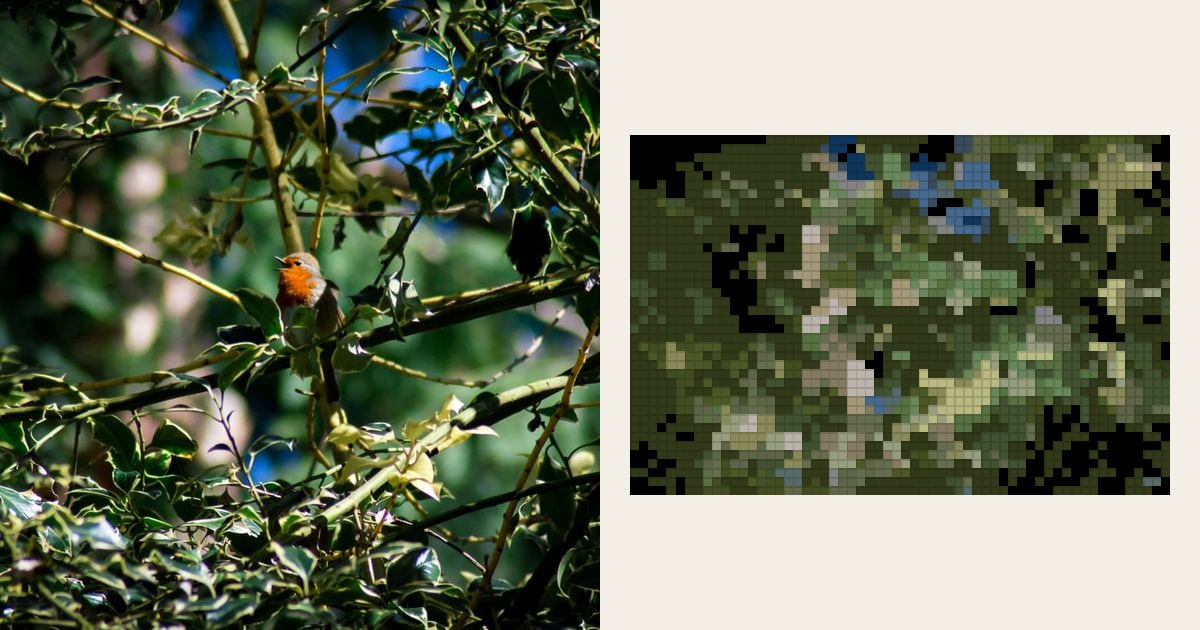
You find a lovely photo of a robin, run it through a converter, and open the chart. Leaves, shadows, a few blue patches. No bird.
We made exactly that mistake on purpose. Our test bird cross stitch pattern came from a wide photo with a small robin in it. At 60 stitches wide, the chart had 0 orange stitches. Below are the numbers, the fix, and a simple way to crop a bird photo before you start.
Why did my bird disappear from the cross stitch chart?
Look at the photo. The robin sits on a branch, a small orange patch among dark holly leaves. Leaves fill most of the frame. The photo is 1,200 pixels wide, and the bird takes up a small part of that.
A converter has a fixed budget: so many stitches, and up to 20 colors. It matches each square to the nearest thread. Dark green leaves and black shadow cover the most squares, so they win the colors. The bird covers few squares, so its orange never made the cut. That is our reading of the numbers, and the key bears it out.
At 60 stitches wide, the 20 threads were dark greens, black, a few grays and beiges, and three blues. The busiest was DMC 934 Avocado Green Black, with 938 of 2,400 stitches, 39.1 percent of the chart. Not one thread was orange.
What happens when you make the chart wider?
A bird cross stitch pattern from a wide photo needs a lot of stitches to keep the bird. We ran the whole photo at four widths with 20 colors and DMC thread. We counted the stitches in orange threads, since the robin's breast is the only large orange thing in the picture.
| Width x height | Stitches | Orange stitches | Share of chart | Lone stitches left | Busiest thread share |
|---|---|---|---|---|---|
| 60 x 40 | 2,400 | 0 | 0% | 19 | 39.1% |
| 80 x 53 | 4,240 | 70 | 1.7% | 33 | 37.1% |
| 100 x 67 | 6,700 | 150 | 2.2% | 39 | 35.0% |
| 160 x 106 | 16,960 | 311 | 1.8% | 90 | 30.5% |
Table 1. The uncropped robin photo at four widths. Share is arithmetic on the converter's counts. Figures from the Threadhood converter, run on 3 November 2026.
Widening helps, but slowly. Even at 160 wide, a chart of nearly 17,000 stitches, orange is under 2 percent of the whole. At 160 wide the busiest thread was still DMC 934, with 5,180 stitches. That is 3 skeins of one dark green, and it is the same thread that led at every width.
Notice the lone stitches too. They grow from 19 to 90 as the chart widens, because a leafy scene produces many single squares. Each one is a start and a finish on the back of your fabric.
How do I crop a bird photo for cross stitch?
Crop until the bird fills most of the frame. Here is the same robin, cropped tight, at three smaller widths. This time we also set the Colors slider to 12.
| Width x height | Stitches | Threads | Orange stitches | Share of chart | Busiest thread share |
|---|---|---|---|---|---|
| 40 x 33 | 1,320 | 12 | 93 | 7.0% | 24.3% |
| 60 x 50 | 3,000 | 12 | 283 | 9.4% | 21.9% |
| 80 x 67 | 5,360 | 12 | 399 | 7.4% | 20.1% |
Table 2. The tight crop at three widths, 12 colors, DMC. Share is arithmetic on the converter's counts. Figures from the Threadhood converter, run on 3 November 2026.
The bird is back at every size, and it is a big part of the picture: 7 to 9 percent of stitches, where before it was 2 percent at best. A 40 stitch wide chart, only 1,320 stitches, holds 93 orange stitches. The uncropped chart needed 100 wide to reach 150.
One honest caveat. The two tables differ in two ways: the crop and the color count (12 against 20). We did not run the tight crop at 20 colors in this test, so we cannot say how much each change did. What we can say is that a chart with fewer colors still kept the bird once the bird filled the frame. That points at the crop as the fix.
Our settings test on a robin looked at how width, colors and blending change a cropped bird, if you want to go further.
A simple crop check
Before you crop, do three things.
- Name the bird's main colors. For a robin it is orange and brown.
- Guess what share of the photo they cover. If it is a sliver, crop.
- Cut branches, sky and ground that the bird does not need. Leave a little room around the bird, so it does not look cramped.
After you run the chart, check the key. If the bird's main color is missing or has only a few stitches, the bird is probably gone. Crop again before you buy any thread.
What about the beak and the eye?
Fine details such as an eye or a beak line are hard to show in whole crosses, and our charts hold full crosses only. DMC says the cross stitch is often joined by a second stitch:
"Ideal for beginners, cross stitch only uses one stitch, the cross stitch, and occasionally a straight backstitch for outlining."
That occasional backstitch is the standard fix for a bird cross stitch pattern. Stitch the body in crosses from the chart, then add the eye and beak by hand over the top. We do not chart backstitch yet.
Choosing a bird photo that works
The best bird cross stitch pattern starts with the right photo. Our wider study of six photos found that tidy subjects convert best. See what six photos at one setting showed. For birds, three habits help.
- Pick a photo where the bird is large. Close shots from a feeder, a fence post or a window sill beat a tiny bird in a tree.
- Look for a soft or plain background. Blur is your friend, because blur turns into a few big patches of color.
- Keep the light on the bird. Shade swallows detail, and a bird in shade is a dark blob.
The guide to choosing a photo goes through more examples. And if you want the full routine, from photo to finished chart, follow our guide to turn a picture into cross stitch.
The robin photo is CC0, from Wikimedia Commons, so you may use it to try everything above.

Ready to chart your own bird? Crop it tight, then open the Threadhood pattern maker and check the key for the bird's colors. It is free, and your photo stays on your device.
Frequently asked questions
Why did my bird disappear from the cross stitch chart?
The bird was too small in the photo. At a low width each stitch covers a big patch of picture, and the converter spends its limited colors on the largest areas, such as leaves and shadow. Crop so the bird fills most of the frame.
How do I crop a bird photo for cross stitch?
Crop to the bird and a little space around it, cutting away branches, sky and ground. Check the result by asking whether the bird's main colors would be among the most common in the picture. If not, crop tighter.
How many stitches wide should a bird chart be?
With a tight crop, our robin kept its orange at 40, 60 and 80 wide. 60 wide gave 3,000 stitches, a good size for a small frame. Uncropped, we needed 100 wide to get 150 orange stitches, which is a much bigger project for a smaller bird.
Can I stitch the beak and eye?
The chart holds full crosses only, so tiny details such as an eye or a beak line may be lost. Many stitchers add them afterward in backstitch, by hand.
Try it with your own photo
The pattern maker runs in your browser. No account, no upload, and you see the chart in seconds.
Open the cross-stitch pattern maker