Academy
How to Read a Cross Stitch Pattern: Symbols and Key
By Threadhood Content Team · · 6 min read
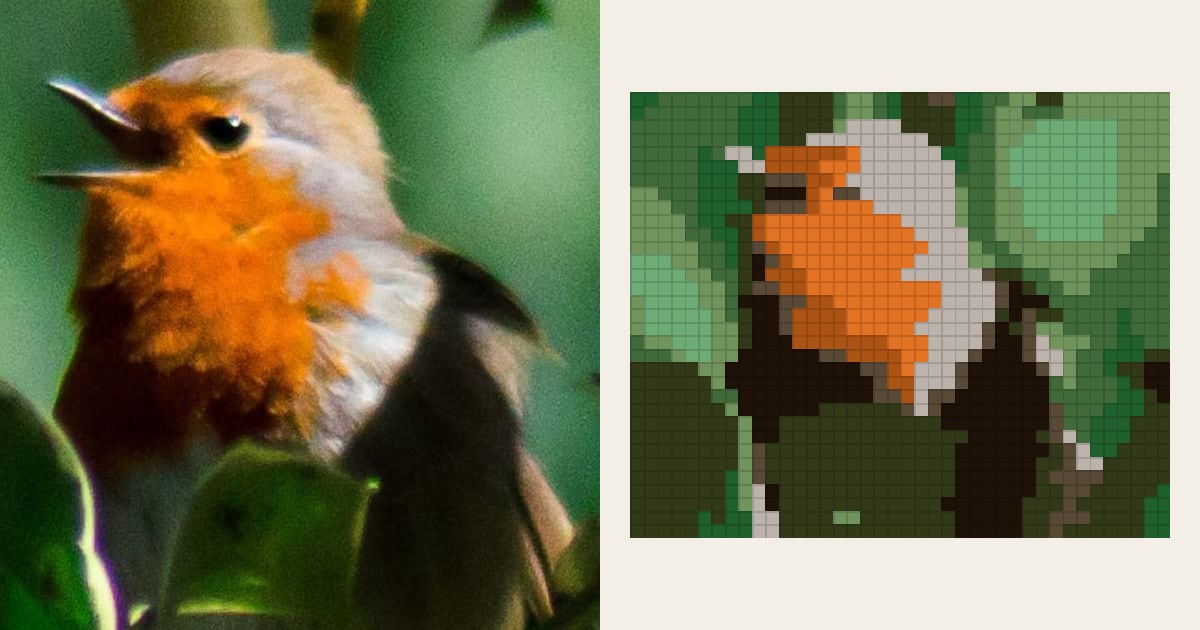
You open a chart and see a wall of tiny symbols. Dots, hashes, at signs. Where on earth do you begin?
It is easier than it looks. This guide shows how to read a cross stitch pattern in a few minutes, using a real chart we made from a robin photo. You will know what every part means, and where your first stitch goes.
What is on a cross stitch chart?
Three things. Once you spot them, any chart makes sense.
- The grid. Each square is one cross stitch.
- The symbols. Each symbol stands for one thread color.
- The key. It tells you which thread belongs to which symbol.
DMC describes how those squares map to cloth on aida:
"Cross stitch is often worked on aida fabric where you form the cross stitches over each intersection of the fabric using the clearly identifiable holes. If you prefer to stitch on linen or evenweave the stitches are commonly made "over 2" meaning each stitch is made across two intersections of thread as shown in the diagrams here."
Each square on the chart equals one of those crosses. So learning how to read a cross stitch pattern is mostly learning to match squares to holes.
Our test chart is a tight crop of a robin, 40 stitches wide and 33 high. That is 1,320 stitches in 10 DMC threads.
What do the symbols on a cross stitch pattern mean?
Each symbol is a stand-in for a thread. That is all. The symbol itself has no meaning. The key is the dictionary.
Here is the key from our robin chart.
| Symbol | DMC code | Name | Stitches |
|---|---|---|---|
| × | 934 | Avocado Grn Black | 323 |
| • | 3346 | Hunter Green | 176 |
| + | 3347 | Yellow Green Medium | 161 |
| # | 3371 | Black Brown | 160 |
| % | 648 | Beaver Gray Light | 119 |
| @ | 922 | Copper Light | 93 |
| & | 913 | Nile Green Medium | 93 |
| $ | 319 | Pistachio Grn Very Dark | 86 |
| = | 838 | Beige Brown Very Dark | 61 |
| ? | 920 | Copper Medium | 48 |
Table 1. The key for the 40 x 33 robin chart. Figures from the Threadhood converter, run on 3 November 2026.
Read it row by row. The first row says: wherever you see an x, stitch with DMC 934, Avocado Green Black. There are 323 of them. The last row says the question mark is DMC 920, Copper Medium, with 48 stitches.
Our key lists the busiest thread first, so you see the main color at the top. Another chart might list by code, or by symbol. Look at the whole key before you shop. The 40 x 33 robin chart totals 1,320 stitches, which you can check by adding the last column. It comes to 1,320 exactly.
Two orange threads, 922 and 920, make up the robin's breast. They add up to 141 stitches, from 93 plus 48.
Why symbols differ between charts
There is no standard. One chart uses a triangle for black, another uses a heart. So never carry a symbol from one chart to the next. Each chart has its own key, and the key is always the boss.
Some charts also show color blocks, or both color and symbol. Threadhood charts show symbols on color, so you can see the picture and read the symbol at once.
A close look at one patch
Here is a 20 x 14 excerpt from the robin chart. This is what you will see when you stitch.
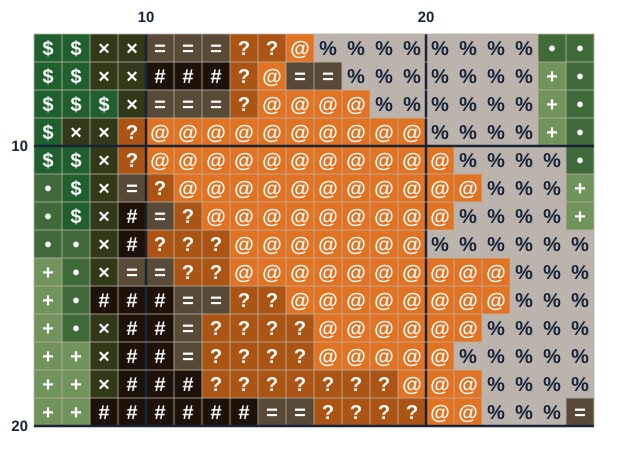
Figure 1. A 20 x 14 excerpt of the robin chart. Figures from the Threadhood converter, run on 3 November 2026.
Look at what you can see:
- Orange squares with @ and ? are the robin's breast. They are the two copper threads from the key.
- Gray squares with % are the soft background (Beaver Gray Light, 648).
- Dark squares with # and x are the shadowed feathers and the dark green.
- A bold line cuts across the chart every 10 stitches, and numbers sit on the heavy lines.
Those bold lines are the best help you have. You do not need to count 20 squares one by one. Count to the bold line, then count a few more. Nobody reads a chart square by square. You read it in chunks of 10, and your eye soon learns to take in a whole block at a glance.
Where do I start on a cross stitch chart?
At the center. Always the center, unless a pattern says otherwise.
Why? If you start in a corner and miscount, you may run out of cloth on the far side. Start in the middle and you spread the error evenly. You also see sooner if the design sits off to one side.
Here is how to do it.
- Find the middle of the chart. On our 40 x 33 chart, that is near column 20 and row 17.
- Fold your cloth in half each way. The crease crossing is the middle.
- Make your first cross there, in the thread for that square.
- Work outward, using the bold lines to keep count.
Our guide to cross stitch for beginners walks through the first stitches in more detail. DMC also has a short video on how to read a chart if you prefer to watch.
Reading the numbers around the chart
Along the edge you will see numbers. They count stitches from the left and from the top. Every 10th line is bold and numbered, so you can find square 25 by counting 5 past line 20.
The width and height in stitches are your size. Divide each by the fabric count to get inches. Our 40 x 33 chart on 14-count Aida is 2.9 x 2.4 inches, and with 3 inch margins you would cut 8.9 x 8.4 inches. The fabric calculator does the sums for any chart.
Digital and PDF charts
Many charts now come as a PDF. A good one has a cover page, a key, and the chart split across pages with bold lines. Some also mark the center. We cover this in our guide to the cross stitch PDF pattern.
On a phone or tablet you can zoom, which helps small symbols. But the reading is the same: key, grid, center. If you print a chart instead, check that the symbols are still sharp on paper, because a blurry key is the quickest way to stitch the wrong thread.
Practice on your own picture
The fastest way to learn how to read a cross stitch pattern is to make a chart and read it. Open the Threadhood Studio, choose a photo, and look at the key it builds. Tap any thread to see its match and swap it if you want. It is free to try.
Frequently asked questions
What do the symbols on a cross stitch pattern mean?
Each symbol stands for one thread color. The key beside the chart tells you which thread, usually with the brand code and color name. The same symbol can mean something different on another chart, so use the key that came with your chart.
Where do I start on a cross stitch chart?
Start at the center. Find the middle of the chart, where the center lines meet, and the middle of your cloth, then stitch outward from there. This keeps the design centered on the fabric.
Why are there bold lines on my chart?
The bold lines mark every 10 stitches. They make it quick to count where you are, and to match a spot on the chart to a spot on the cloth.
Does one square on the chart equal one hole on the fabric?
On Aida, yes: one square is one cross over one block. On evenweave or linen worked over two, one square is a cross over two threads each way.
Try it with your own photo
The pattern maker runs in your browser. No account, no upload, and you see the chart in seconds.
Open the cross-stitch pattern maker