Reviews
Custom Cross Stitch Pattern: Commission or Make One?
By Threadhood Content Team · · 6 min read
You want something stitched from your own picture: a cat, a wedding, a kid at the beach. Searches for a custom cross stitch pattern turn up shops that sell them, and apps that make them. Which should you use?
Our view: a custom pattern is mostly a conversion plus a few choices. A converter does the conversion in seconds. We make Threadhood, so we are not neutral. Here are the numbers from one real chart, and a plain guide to when paying someone is the better call.
What is a custom cross stitch pattern, really?
Strip away the shop language and you get three parts.
- A grid. Your picture, cut into squares, one square per stitch.
- A palette. Each square matched to a real thread color, with a symbol.
- A shopping list. The thread numbers, stitch counts and finished size.
Personalized cross stitch patterns, custom kits and portraits all rest on those three parts. A kit adds fabric, needle and thread in a box. A portrait is the same thing with a face in it.
A person can do the first two by hand, but it is slow. A converter does it in seconds, using the real thread list. Where a human adds value is judgement: redrawing, simplifying, adding outlines. That is the part worth paying for.
What a custom cross stitch pattern looks like in numbers
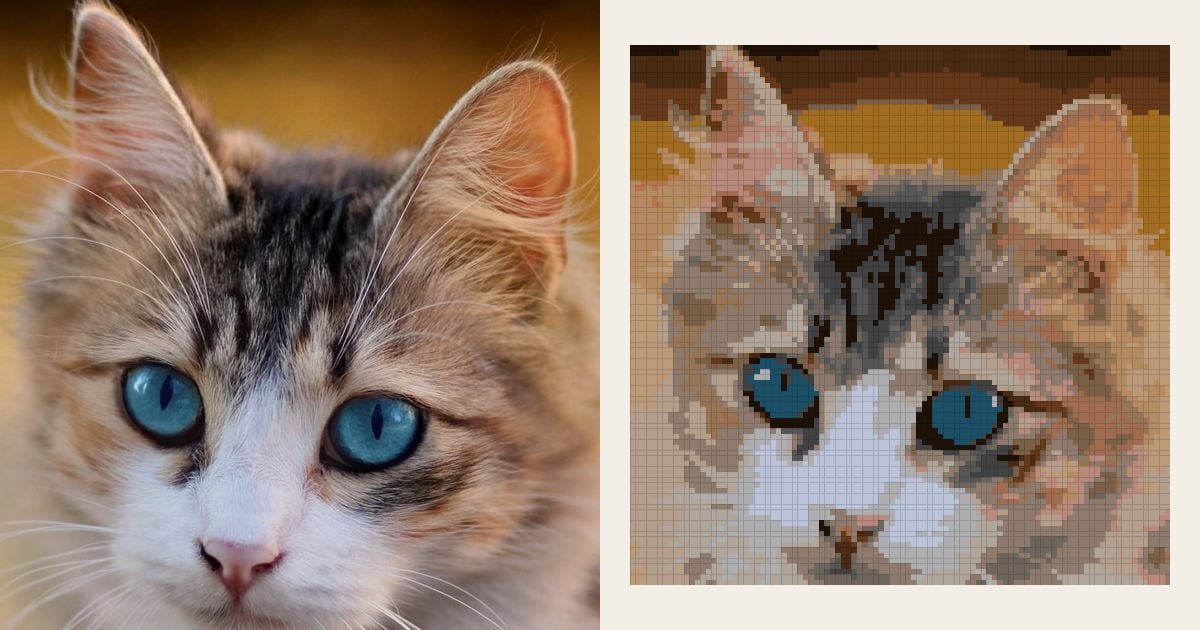
We took a tabby cat's face, cropped to a square, and charted it three times in DMC at 20 colors. The only thing we changed was the width.
| Width | Stitches | Threads | Size on 14-count | Fabric to cut (3 in margin) | Skeins | Busiest thread share |
|---|---|---|---|---|---|---|
| 60 | 3,600 | 20 | 4.3 x 4.3 in | 10.3 x 10.3 in | 20 | 14.2% |
| 100 | 10,000 | 20 | 7.1 x 7.1 in | 13.1 x 13.1 in | 20 | 14.7% |
| 140 | 19,600 | 20 | 10.0 x 10.0 in | 16.0 x 16.0 in | 21 | 11.3% |
Table 1. One tabby face, three widths, 20 colors each. Figures from the Threadhood converter, run on 3 November 2026.
Three things jump out.
The thread list barely changes. Going from 60 to 140 wide made 5.4 times as many stitches, but the shopping list stayed at 20 threads. The extra stitching is more of the same colors. Only the biggest size needed a 21st skein, because the busiest thread, DMC 07 Driftwood, took 2,207 stitches. One skein covers about 1,826 full crosses on 14-count with two strands.
Clean-up grows with the chart. The converter's Tidy lone stitches setting changed 154, 307 and 508 stitches to match their neighbors. After that, only 3, 2 and 3 single stitches were left. That matters because every lone stitch is a thread to start and end.
Size is a choice, not a fee. There is no price per stitch here. You pick the width and the chart appears. In our test the 100-wide chart is the one we would stitch: 7.1 inches square is a frame-able size, and ten thousand stitches is a long but fair project.
The chart is still only as good as the photo. Our guide to choosing a photo shows what to look for. The cat is a CC0 photo on Wikimedia Commons.

Should I commission a custom cross stitch pattern or make one?
Make your own when:
- You want control. You can swap any thread in the key, or leave the background as bare fabric.
- You need it fast. A gift with a deadline cannot wait for a quote and a draft.
- The photo is already good. Sharp, one subject, light from one side.
- You want to see options. Change the width, change the colors, compare.
Commission when:
- The image needs work. A faded print, a blurry phone shot, a child's drawing, a logo with thin lines. A person can redraw what a converter can only guess at.
- You want backstitch. Backstitch is the thin line stitch used for outlines and whiskers. Threadhood makes full crosses only. We do not add backstitch, half stitches or quarter stitches yet. If your design depends on them, a designer or other software is the honest answer.
- You do not want to touch a computer. Fair enough.
- You want a particular style, such as a simplified or stylized look rather than a literal copy of the photo.
A tabby's eyes and fine whiskers are tiny, and a grid has few stitches to spend on them. A designer could redraw those in a few well-chosen stitches, and add whiskers in backstitch. That is a real use for a person.
If you want to try the other way first, the pattern maker is free to use in a browser, and the photo stays on your device. Our how to make your own pattern guide covers the full kit list.
How much does a custom cross stitch pattern cost?
We cannot tell you. We do not take commissions, so we have no prices to quote, and we will not guess at other people's rates. Ask for a written quote.
What to ask a designer before you pay:
- What size is the finished design in stitches, and on which fabric count?
- How many colors, and which thread brand will the key use?
- Is backstitch included? Are half or quarter stitches used?
- What do I get: a PDF chart, a key, a shopping list?
- How many revisions are included, and how long will it take?
- Do you need the photo's copyright, and who owns the finished pattern?
That last point matters. The U.S. Copyright Office says:
"Your work is under copyright protection the moment it is created and fixed in a tangible form that it is perceptible."
U.S. Copyright Office, Copyright FAQ
A photo you took is yours, so you can hand it over. A photo you found online is probably someone else's work. Send only photos you have the right to share.
Making your own costs nothing to chart and download. Free accounts save 3 charts. Studio is $4.99 a month or $29 a year, and adds unlimited saved charts, stitch-by-stitch progress, a thread stash with shopping lists and the printable PDF kit. Twelve months at the monthly price is $59.88, so the yearly plan costs $30.88 less. See pricing for what each plan includes.
A fair verdict
A custom cross stitch pattern from a good photo is a job a converter does well, and for most gifts it is all you need. Pay a person when the picture needs a human eye or you need stitches we do not make.
If you decide to make it yourself, our step-by-step pattern guide walks through each choice, and the Threadhood custom pattern maker is open now. Pick your photo, try 100 stitches wide, and read the key before you buy any thread.
Frequently asked questions
Should I commission a custom cross stitch pattern or make one?
Make one if the photo is clear and you are happy with full crosses. Commission one if the image needs redrawing, such as a damaged old print or a logo, or if you want backstitch outlines or special stitches that a converter does not add.
How much does a custom cross stitch pattern cost?
We do not know, because we do not sell commissions and have no price list to quote. Ask designers for a written quote. Making your own with Threadhood is free to chart and download. Studio is $4.99 a month or $29 a year if you want unlimited saved charts, progress tracking, stash and the PDF kit.
Can I use any photo for a custom cross stitch pattern?
Use photos you took yourself or that are free to use. A photo you took is yours. If a designer makes the chart, give them only photos you have the right to share.
How big should a custom cross stitch portrait be?
For a pet face, we got a clear result at 100 stitches wide, which is about 7.1 inches on 14-count Aida. Faces of people need at least that, and more is safer.
Try it with your own photo
The pattern maker runs in your browser. No account, no upload, and you see the chart in seconds.
Open the cross-stitch pattern maker