Academy
Make Your Own Cross Stitch Pattern: A Kit List
By Threadhood Content Team · · 7 min read
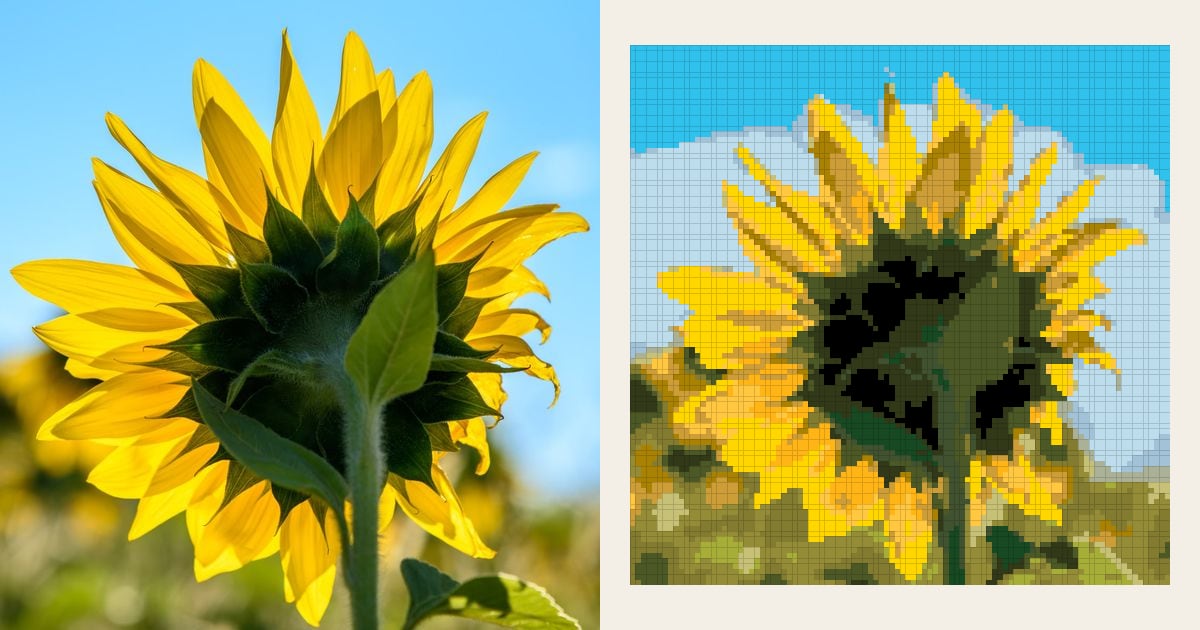
You've stitched other people's patterns for years. Now you want to stitch your garden, your dog, your view. The trouble is that a chart on its own isn't a project. You also need to know what to buy, how big to cut the fabric and how long it'll take.
This guide shows how to make your own cross stitch pattern and the full kit list that goes with it.
We did it for real, with one sunflower photo. Every number below came from the Threadhood pattern maker and its calculators: 10,000 stitches, 18 threads, 18 skeins and one awkward blue.
Why make your own cross stitch pattern at all?
Stitchers have been drawing their own charts for a very long time. Bristol Museums holds a Berlin woolwork pattern printed between 1830 and 1870 by Grünthal's Verlag. The museum's catalogue describes it like this:
"Squared pattern, coloured by hand: long motif of pink and red roses, small blue flowers and yellow feather scrolls. Colour code with 42 colours."
Bristol Museums, object Na2478.12
That's a chart and a key, the same two things you'll make today. The difference is that someone colored those squares by hand. A pattern maker now does that part in seconds, so you can spend your time on choices only you can make.
The best reasons to create your own cross stitch pattern:
- It's personal. Nobody sells a chart of your cat.
- You control the size. Make it fit the frame you already have.
- You can design around your stash. Swap threads for ones in your drawer.
Step 1: Choose and prepare the photo
We picked a CC0 photo of a sunflower from below, against a clear blue sky. It has three things that chart well: a bold shape, strong color and a plain background.
It's square, so we left it uncropped. If your subject doesn't fill the frame, crop first. Our guide to turning a picture into a cross stitch pattern covers photo choice step by step.
Step 2: Make the chart
We opened the cross stitch pattern maker, tapped Choose a photo and set:
- Width: 100 stitches (the photo is square, so 100 high too)
- Colors: 18
- Thread brand: DMC
- Tidy lone stitches: on
The result: a 100 x 100 chart, 10,000 stitches and 18 DMC threads. The clean-up step changed 387 lone stitches to match their neighbors and left only 3 single stitches in the whole chart.
Step 3: Read the thread list
Here's the complete key, busiest thread first. This is your shopping list.
| DMC | Name | Stitches | Skeins | Closest Anchor | ΔE |
|---|---|---|---|---|---|
| 827 | Blue Very Light | 1,511 | 1 | 128 | 2.7 |
| 996 | Electric Blue Medium | 1,506 | 1 | 433 | 8.9 |
| 444 | Lemon Dark | 1,259 | 1 | 290 | 0.5 |
| 936 | Avocado Green Very Dark | 683 | 1 | 861 | 4.8 |
| 934 | Avocado Grn Black | 668 | 1 | 269 | 4.8 |
| 730 | Olive Green Very Dark | 662 | 1 | 844 | 1.8 |
| 3852 | Straw Very Dark | 618 | 1 | 943 | 4.9 |
| 732 | Olive Green | 582 | 1 | 280 | 2.1 |
| 725 | Topaz Medium Light | 491 | 1 | 305 | 2.4 |
| 310 | Black | 372 | 1 | 403 | 0.0 |
| 3829 | Old Gold Vy Dark | 367 | 1 | 907 | 4.1 |
| 972 | Canary Deep | 304 | 1 | 298 | 0.9 |
| 813 | Blue Light | 219 | 1 | 144 | 1.7 |
| 986 | Forest Green Very Dark | 188 | 1 | 861 | 2.8 |
| 734 | Olive Green Light | 171 | 1 | 842 | 2.7 |
| 890 | Pistachio Green Ultra Dark | 164 | 1 | 218 | 1.3 |
| 581 | Moss Green | 125 | 1 | 255 | 6.3 |
| 523 | Fern Green Light | 110 | 1 | 858 | 2.8 |
Table 1. The full key for the sunflower chart. Skeins are for 14-count Aida with two strands. ΔE is the CIEDE2000 difference to the nearest Anchor thread: under 1 looks identical, over 5 looks like a different color.
Three things stand out.
Sky is a big share of the thread. The two sky blues alone are 3,017 stitches, about 30% of the chart.
DMC 996 is the awkward one. Electric Blue Medium has no close twin in the Anchor range. The nearest, Anchor 433, is 8.9 apart, and on a sky that's a visibly different blue. If you stitch with Anchor, switch Thread brand to Anchor before you start and let the maker pick from Anchor's own colors. Our DMC to Anchor conversion chart marks every color with a gap like this.
The yellows convert perfectly. DMC 444 to Anchor 290 is 0.5 apart, and 972 to 298 is 0.9. You'd never see the difference.
How many skeins of floss do I need?
For this chart, 18: one of each color.
Here's the arithmetic. A skein of DMC or Anchor six-strand cotton is 8 m of six strands. With two strands on 14-count Aida, and half again for starting tails and travel between areas, one skein covers about 1,826 full crosses. The busiest thread here, 827, uses 1,511 stitches, so even it fits in one skein.
That changes with the fabric and strands:
| Fabric | Strands | Crosses per skein (about) |
|---|---|---|
| 11-count Aida | 3 | 956 |
| 14-count Aida | 2 | 1,826 |
| 14-count Aida | 3 | 1,217 |
| 16-count Aida | 2 | 2,087 |
| 18-count Aida | 2 | 2,348 |
Table 2. How far one skein goes. From Threadhood's skein formula; the same numbers drive the floss calculator.
So on 11-count with three strands, our two blues would need two skeins each. The floss calculator does this for any stitch count.
How much fabric do I need for a cross stitch?
Work out the design size, then add a margin.
Design size is stitches divided by fabric count. Our 100 stitches on 14-count Aida is 100 / 14 = 7.1 inches (18.1 cm) each way. On 18-count it would be 5.6 inches.
Then add 3 inches on every side for framing and mounting. That gives 13.1 x 13.1 inches (33.4 cm) to cut. Round up rather than down; a little extra fabric never hurt anyone. The fabric size calculator handles evenweave and linen too, counting 28-count over two as 14 stitches per inch.
The full kit list for our sunflower
| Item | What we chose | Why |
|---|---|---|
| Fabric | 14-count Aida, at least 13.1 x 13.1 in | Easy to count; 7.1 in finished size |
| Thread | 18 skeins of DMC six-strand cotton | One per color in Table 1 |
| Strands | 2 | Usual coverage on 14-count |
| Needle | Tapestry needle (blunt tip) | Slides through Aida holes without splitting threads |
| Hoop or frame | Big enough to move around a 7 in design | Keeps tension even |
| Chart | Threadhood chart with symbols and grid | Bold line every 10 stitches for counting |
Table 3. Everything you need to start, from one photo.
How long will it take to stitch?
That depends on you, so here's the sum rather than a promise. The chart has 10,000 stitches. At 100 crosses an hour, it's 100 hours. At 200 an hour, 50. Time yourself for one evening and you'll know your own number.
Big projects are why progress tracking helps. On the Studio plan, you can tap stitches as you finish them and see each thread's percentage, which keeps a long project moving. Our launch post explains how that works.
Mistakes to avoid when you create your own cross stitch pattern
- Too many colors for the size. Each color is at least one skein, so 40 colors on a small chart is an expensive bookmark.
- Converting brands at the end. Our sky blue shows why. Chart in the brand you'll buy.
- Skimping on fabric. Three inches a side feels generous until the framer asks for it.
- Using a photo you don't own. As the U.S. Copyright Office puts it, your work is protected "the moment it is created and fixed in a tangible form." So is everyone else's. Use your own photos, or CC0 ones like ours.
- Skipping a test patch. Stitch a small corner first to check your strands give the coverage you like.
Make your own cross stitch pattern tonight
You've got everything you need: a photo, a chart, a thread list and a fabric size. Open the cross stitch pattern maker, choose your photo and work through the same three steps. When the key is right, tap Download for the chart and key, and take the thread list to the shop.
Frequently asked questions
How many skeins of floss do I need for a cross stitch?
One skein of six-strand cotton covers about 1,826 full crosses on 14-count Aida with two strands, allowing extra for tails. Divide each color's stitch count by that and round up. Our 10,000-stitch sunflower needed one skein of each of its 18 colors.
How much fabric do I need for a cross stitch?
Divide the stitches by your fabric count to get the design size in inches, then add 3 inches on every side for framing. A 100 by 100 stitch design on 14-count Aida is 7.1 inches square, so cut at least 13.1 inches square.
Can I sell a cross stitch pattern I made from a photo?
Only if you have the rights to the photo. A photo you took is yours. Someone else's photo is protected by copyright from the moment it's taken, so use your own pictures or ones released as CC0.
Is it cheaper to make your own cross stitch pattern than to buy one?
The chart itself can be free. Thread is the main cost, and it depends on the number of colors more than the size, since each color needs at least one skein. Designing around thread you already own saves the most.
Try it with your own photo
The pattern maker runs in your browser. No account, no upload, and you see the chart in seconds.
Open the cross-stitch pattern maker