Academy
Cross Stitch for Beginners: A Calm Start-to-Finish Guide
By Threadhood Content Team · · 7 min read
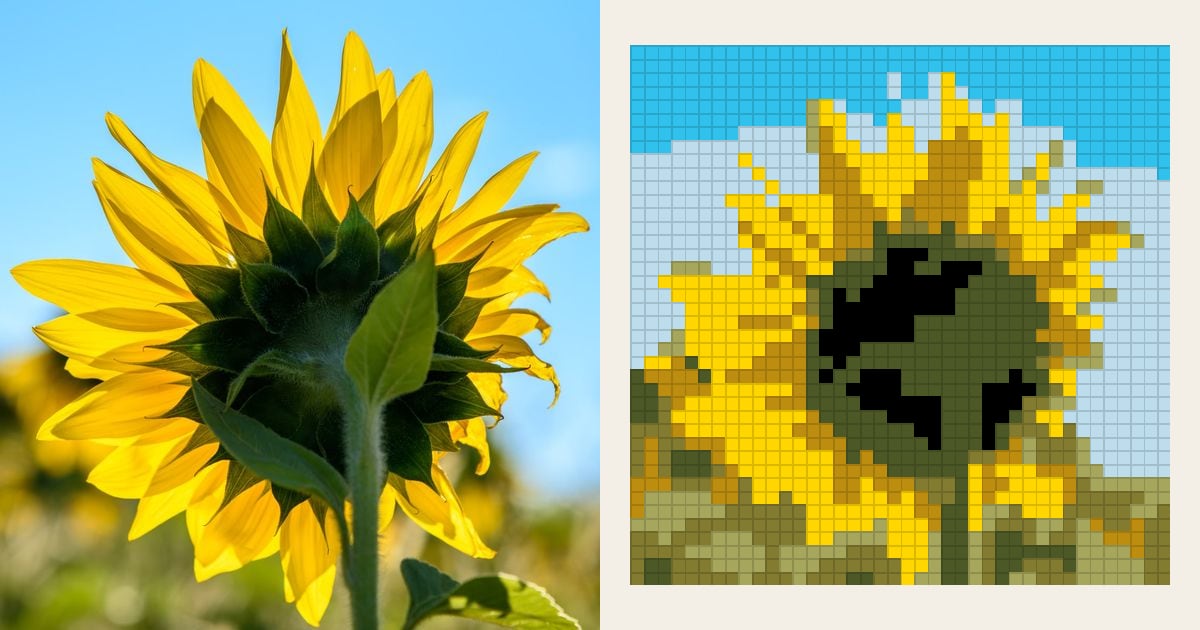
Cross stitch looks fiddly from the outside. Little squares, dozens of thread numbers, a needle that seems too big or too small. It is far easier than it looks.
This guide covers cross stitch for beginners from the first shopping trip to the last stitch. We also charted a real 40 x 40 sunflower, so you can see what a gentle first project costs in stitches and thread.
What is cross stitch, in plain words?
You make little X shapes on cloth with a needle and thread. A chart tells you where each X goes and what color it is. Put enough of them side by side and a picture appears.
DMC says it neatly:
"Ideal for beginners, cross stitch only uses one stitch, the cross stitch, and occasionally a straight backstitch for outlining."
One stitch. That is the whole skill. Everything else is counting, patience and picking the right color.
Most charts are worked on aida, a fabric with a grid of clear holes. DMC describes it like this: you "form the cross stitches over each intersection of the fabric using the clearly identifiable holes." You never have to guess where to go. The holes tell you.
What do I need for cross stitch?
Less than you think. Here is a first kit.
| Item | What to get | Why |
|---|---|---|
| Fabric | 14-count Aida | The count is stitches per inch, and DMC recommends 14-count for beginners |
| Floss | The threads listed in your chart key | Each color is one skein |
| Needle | A blunt tapestry needle | It slides through the holes without splitting the cloth |
| Scissors | Small and sharp | Clean tails, no frayed ends |
| Chart | A small, bold design | Fewer colors, less sorting |
| Hoop or frame | Optional | Keeps the cloth flat |
Table 1. A simple first kit for cross stitch for beginners.
Beginner cross stitch kits bundle most of this together. They are handy because someone else has already picked the thread. But you can also make your own chart and buy only what it needs, which is how we did it below.
What a first project looks like
Let's make it real. We ran a sunflower photo through the Threadhood converter at 40 stitches wide and 8 colors. These are the results.
| Measure | Result |
|---|---|
| Grid | 40 x 40 stitches |
| Stitches | 1,600 |
| Threads | 8 DMC |
| Finished size on 14-count Aida | 2.9 x 2.9 inches |
| Fabric to cut, with 3 inch margins | 8.9 x 8.9 inches |
| Busiest thread | Lemon Dark (444), 298 stitches, 18.6% of the chart |
| Lone stitches left | 0 |
Table 2. The 40 x 40 sunflower chart. Figures from the Threadhood converter, run on 3 November 2026.
That is a tiny design. Small enough to finish, big enough to look like a flower. Here is the full key.
| Thread | Name | Stitches |
|---|---|---|
| 444 | Lemon Dark | 298 |
| 827 | Blue Very Light | 294 |
| 996 | Electric Blue Medium | 241 |
| 936 | Avocado Green Very Dark | 220 |
| 680 | Old Gold Dark | 191 |
| 730 | Olive Green Very Dark | 152 |
| 3012 | Khaki Green Medium | 122 |
| 310 | Black | 82 |
Table 3. The key for the 40 x 40 sunflower chart. Figures from the Threadhood converter, run on 3 November 2026.
Each of these eight threads needs one skein, so you buy 8. A skein covers about 1,826 stitches on 14-count with 2 strands. All 1,600 stitches of this chart together are fewer than that. So you will have plenty left over, and you can start a second small project with the scraps.
Want a different size or fabric? The floss calculator shows skeins for any chart.
Why only 8 colors?
Because a first project should be calm. We also tried 6 and 12 colors on the same photo.
| Colors asked for | Threads used | Lone stitches left |
|---|---|---|
| 6 | 6 | 0 |
| 8 | 8 | 0 |
| 12 | 12 | 1 |
Table 4. The same 40 x 40 chart at three color counts. Figures from the Threadhood converter, run on 3 November 2026.
Fewer colors mean fewer skeins to buy and fewer thread changes. More colors mean a closer match to the photo. For cross stitch for beginners we like 8. You get the flower, and you do not drown in thread.
How do I start cross stitch?
Follow these steps in order.
1. Find the center
Fold your cloth in half one way, then the other. Where the folds meet is the center. Your chart has a center too: count to the middle square. Start both from there. Starting at the center means you will never run out of cloth on one side.
2. Prepare your thread
Floss comes as six thin strands twisted together. Pull out two, then lay them side by side and thread them through the needle. Two strands is the standard on 14-count Aida. On 11-count, use three. We explain why in our guide to 14-count Aida.
3. Make one cross
Bring the needle up through a hole, then down through the hole diagonally across from it. That is half a cross. Now come back the other way over the top to finish it. Keep the top diagonal of every cross pointing the same direction, and the work looks tidy.
Many stitchers work a row of half crosses and then return along it to finish them. Others complete each cross before moving on. Both give the same result, so try each and keep the one that feels better.
4. Work one color at a time
Finish an area in one color before you pick up the next. Do not carry thread long distances across the back. Weave the tail under a few stitches instead.
5. Keep tension gentle
Pull the thread snug, not tight. Tight stitches pucker the cloth. Loose ones look sloppy. You will find the feel within a few dozen crosses.
What if I want a picture of my own?
You can make the chart yourself, which is a good way into the hobby. Choose a bold photo with one clear subject, then run it through the cross stitch pattern maker. Our photo guide explains what to look for.
Then read the key. Our guide to reading a cross stitch pattern shows what each part means. Charts from Threadhood use full crosses only, with no backstitch, half or quarter stitches yet. That suits a beginner well, since full crosses are the one stitch you are learning.
The best overview of the basics is DMC's own how to cross stitch tutorials, if you like watching someone do it.
First mistakes to expect
Everyone makes these. None are fatal.
- Starting in a corner. It works, but the center is safer, and you can check your margin.
- Counting wrong. Count the squares between two bold lines on the chart, then count the holes on the cloth. Fix it early.
- Too many colors. A 20-color chart is a lot for a first try. Choose 8 or fewer.
- Skipping the key. Always read it before you buy. Some matches are only close, and some will surprise you.
- Pulling too tight. The cloth puckers and the cross shrinks. Relax your hand.
You can unpick any stitch. Use the needle's eye end to ease the thread out, and the cloth forgives you.
Easy cross stitch patterns to try next
Once the sunflower is done, move up a step. The chart gets bigger, not harder. A 50 x 50 chart has 2,500 stitches, and a 70 x 70 chart has 4,900. The skills are the same. Only the number of crosses grows.
If you want to see how size changes things, read how we made a pattern from a photo at several sizes.
Ready to start? Open the Threadhood Studio, choose a bold photo, set it to about 40 stitches wide and 8 colors, and you have a first chart in minutes. It is free to make.
Frequently asked questions
How do I start cross stitch?
Pick a small chart with few colors, buy 14-count Aida and the threads in the key, and cut the cloth with a margin on every side. Find the center of the chart and the cloth, then stitch from there with 2 strands of floss.
What do I need for cross stitch?
You need fabric such as 14-count Aida, embroidery floss in the colors on your chart, a blunt tapestry needle, small scissors and a chart. A hoop or frame helps keep the cloth flat but is not required to begin.
How many strands of floss should I use?
Use 2 strands on 14-count Aida. Floss comes with six strands, so you separate two and thread them together. Use 3 strands on 11-count Aida.
How many colors should a first project have?
Six to eight is plenty. Each color means a new skein and a new thread to start and end. Our 40 x 40 sunflower works with 8.
Try it with your own photo
The pattern maker runs in your browser. No account, no upload, and you see the chart in seconds.
Open the cross-stitch pattern maker