Academy
14 Count Aida: What the Count Means for Your Chart
By Threadhood Content Team · · 7 min read
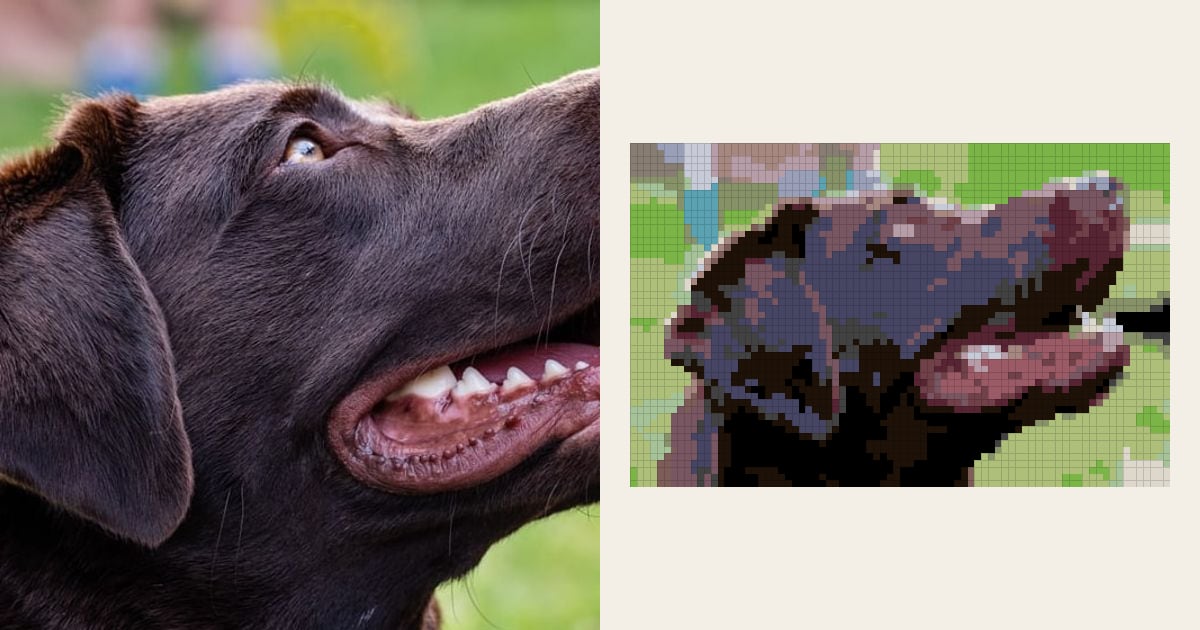
You buy a piece of Aida, start stitching, and the design comes out the wrong size. It is too big for the frame, or so small the face looks like a smudge. The count is the reason.
The fix is easy. 14 count Aida gives 14 stitches per inch, and once you know that, every size follows. Below we ran one real chart, a Labrador face, at six fabric counts and wrote down what changed.
What does the count on Aida mean?
Aida is a woven fabric with a clear grid of holes. The count tells you how many of those squares fit in one inch. DMC puts it simply:
"The “count” of aida refers to the number of stitches you make in an inch. So, the higher the count the smaller the stitches. We recommend beginners use 14-count aida."
Each stitch covers one square. So a count of 14 means 14 squares, or 14 crosses, along each inch. The sums run in one direction:
- Finished width in inches = chart width in stitches divided by the count.
- Squares in one square inch = count times count.
On 14 count Aida that is 196 stitches in each square inch. On 11 count it is 121. On 18 count it is 324. A higher count means more stitches in the same space, so each stitch is smaller and finer.
One chart at six counts
We made a chart from a chocolate Labrador face photo at 80 stitches wide and up to 20 colors. It came out 80 x 51 stitches: 4,080 stitches and 20 DMC threads. Here is what that one chart becomes on each fabric.
| Fabric | Stitches per inch | Finished size | Fabric to cut (3 in margins) |
|---|---|---|---|
| 11 count Aida | 11 | 7.3 x 4.6 in | 13.3 x 10.6 in |
| 14 count Aida | 14 | 5.7 x 3.6 in | 11.7 x 9.6 in |
| 16 count Aida | 16 | 5.0 x 3.2 in | 11.0 x 9.2 in |
| 18 count Aida | 18 | 4.4 x 2.8 in | 10.4 x 8.8 in |
| 28 count evenweave, over two | 14 | 5.7 x 3.6 in | 11.7 x 9.6 in |
| 32 count linen, over two | 16 | 5.0 x 3.2 in | 11.0 x 9.2 in |
Table 1. The 80 x 51 Labrador face chart on six fabrics. Figures from the Threadhood converter, run on 3 November 2026.
Two things stand out. First, the jump from 11 to 18 count shrinks the finished piece from 7.3 inches wide to 4.4. Second, the 3 inch margin on each side stays the same whatever the count, so the cut fabric shrinks more slowly than the design does. Our fabric calculator does the same sums for any chart size, and our worked example for cross stitch fabric shows the steps by hand.
Why 14 count Aida is the usual pick
DMC recommends it to beginners, and the numbers show why. Holes on 14 count Aida are big enough to find without squinting, yet 196 stitches per square inch is fine enough for a face.
It is also the middle of the range. Go lower and a chart needs a lot of fabric. Go higher and you start counting tiny squares.
If you want to know where the stitches of a photo chart land on the fabric, turn a picture into cross stitch at your chosen width and read the size line under the chart. It shows the finished size at 14, 16 and 18 count.
What does the count do to the thread?
Less than you might think. Here is the same chart again, this time counting thread. The strands are our defaults: 3 on 11 count, 2 on everything else.
| Fabric | Strands | Stitches per skein | Exact skeins for the whole chart | Skeins to buy |
|---|---|---|---|---|
| 11 count Aida | 3 | 956 | 4.3 | 20 |
| 14 count Aida | 2 | 1,826 | 2.2 | 20 |
| 16 count Aida | 2 | 2,087 | 2.0 | 20 |
| 18 count Aida | 2 | 2,348 | 1.7 | 20 |
Table 2. Thread for the same 4,080 stitch chart. A skein is 8 m of six strands, with half again allowed for tails and travel. Figures from the Threadhood converter, run on 3 November 2026.
The last column is the surprise. The exact total is 4.3 skeins on 11 count and 1.7 on 18 count, yet you buy 20 skeins either way. That is because the chart has 20 threads, and a thread needs at least one skein however few stitches it has. Our busiest thread in this chart, DMC 471, has 607 stitches, which is well under one skein even on 11 count.
So the count mostly changes the size of the piece and the thickness of the stitch. It barely changes the shopping bill. How strands, count and skeins fit together gets a full page in how many strands for cross stitch.
Is 14 count or 18 count better for a photo chart?
It depends on what you want to hold in your hands.
Choose 14 count Aida if this is your first photo project, if you stitch in the evening, or if you want a piece you can finish. The holes are easy to see, the stitches are quick, and the size matches common frames.
Choose 18 count Aida if you want detail in a small space. The same 80 stitch chart is only 4.4 inches wide, and a 100 stitch square is 5.6 inches against 7.1 on 14 count. That is a real advantage for a pet face or a portrait, where more stitches can mean a better likeness. You pay for it with smaller holes that are harder to see, so plan for good light.
One thing is worth saying plainly: switching fabric does not fix a bad chart. If the photo is cluttered, 18 count just gives you a smaller cluttered picture. Crop and set the width first. Our guide to choosing a photo covers that.
Evenweave and linen, stitched over two
Evenweave and linen have no neat squares. Stitchers work them over two threads, so each cross covers a 2 x 2 block. DMC describes it like this:
"If you prefer to stitch on linen or evenweave the stitches are commonly made "over 2" meaning each stitch is made across two intersections of thread as shown in the diagrams here."
DMC, What is cross stitch
Half the fabric count is the stitch count. 28 count evenweave over two gives 14 stitches per inch, the same as 14 count Aida. 32 count linen over two gives 16, the same as 16 count Aida. Table 1 shows identical sizes for those pairs.
The usual slip is forgetting the halving. Read a 28 count label as 28 stitches per inch and you will cut far too little fabric.
Which count should you buy?
Work backward from the size you want. Say you want a 6 inch wide piece on 14 count Aida: that is 84 stitches wide (6 times 14). Set that width in the pattern maker, check the size line, and cut your fabric a few inches larger all round.
If the size comes out wrong, change the count before you change the chart. A chart that is right but too small on 14 count may be just the right size on 11. Chart first, then fabric, then thread: that order saves the most unpicking.
Ready to try it? Open the Threadhood pattern maker, choose a photo, and read the size line for 14, 16 and 18 count before you buy fabric.
Frequently asked questions
What size is 14 count Aida?
The count is not a fabric size. It means 14 stitches in every inch. A chart 80 stitches wide finishes about 5.7 inches wide on 14 count Aida (80 divided by 14). Cut the fabric larger than that, with a margin of about 3 inches on every side if you plan to frame or hoop it.
Is 14 count or 18 count better for a photo chart?
Neither is better in general. 18 count packs 324 stitches into each square inch against 196 on 14 count, so the same chart finishes smaller, or you can chart wider for the same size. 14 count has bigger holes and is easier to see. Choose 14 for a first project and 18 when you want more detail in a small frame.
Does the count change how many skeins I need?
A little. Our 80 x 51 chart needs about 2.2 skeins of thread in total on 14 count and 1.7 on 18 count. But every thread in the key needs at least one skein, so a 20 thread chart means 20 skeins at either count.
What is 11 count Aida good for?
It has the biggest holes and the biggest stitches, so it suits bold designs. Our default is 3 strands of floss on 11 count instead of 2. The finished piece is larger for the same chart.
Try it with your own photo
The pattern maker runs in your browser. No account, no upload, and you see the chart in seconds.
Open the cross-stitch pattern maker