Academy
Cat Cross Stitch Patterns: Blue Eyes and Whiskers
By Threadhood Content Team · · 7 min read
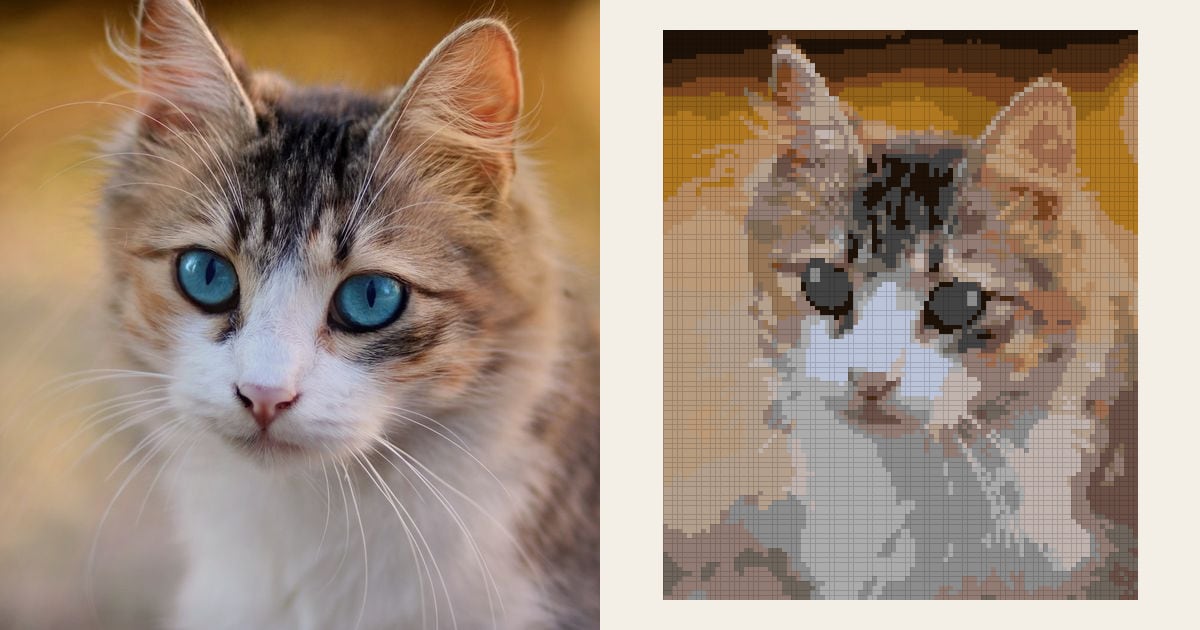
You love your cat. You want a pattern of that exact face, with those exact eyes. So you upload a photo and the chart comes back with a lovely coat and dull gray eyes.
We got the same result. The photo is a tabby with bright blue eyes, and the cat cross stitch patterns we made show where it went wrong and what to do about it. Here is every number.
What happened to the blue eyes?
Blue eyes are the classic trouble spot in cat cross stitch patterns. Open the photo and the first thing you see is two turquoise eyes. Open the chart and the eyes are dark gray with a pale highlight.
The reason lies in the key. The chart at 100 stitches wide and 20 colors contains one blue thread, DMC 157 Cornflower Blue Very Light, a pale blue gray. It has 349 stitches. When we looked at where they sit, they fill the white fur on the muzzle, not the eyes. The converter matches each patch of the photo to the closest thread, and the shadowed white of the fur was closer to that pale blue than to anything else. Bright turquoise would have needed a stronger blue in the key.
That blue thread is about 3 percent of the stitches at every width we tried:
| Width | DMC 157 stitches | Share of chart |
|---|---|---|
| 60 | 112 | 2.6% |
| 80 | 231 | 3.0% |
| 100 | 349 | 2.9% |
| 120 | 500 | 2.9% |
Table 1. The only blue thread in the 20 color key, at four widths (share is arithmetic on the converter's counts). Figures from the Threadhood converter, run on 3 November 2026.
A bigger chart did not give the eyes their blue back. It gave the white fur more of it.
How many stitches wide should a cat cross stitch be?
We ran the same tabby photo at four widths, with DMC thread and up to 20 colors. Sizes are on 14 count Aida.
| Width x height | Stitches | Threads | Size on 14 count | Mean ΔE | Lone stitches | Busiest thread |
|---|---|---|---|---|---|---|
| 60 x 72 | 4,320 | 20 | 4.3 x 5.1 in | 5.0 | 1 | 07 Driftwood (589) |
| 80 x 96 | 7,680 | 20 | 5.7 x 6.9 in | 5.2 | 0 | 451 Shell Gray Dark (801) |
| 100 x 120 | 12,000 | 20 | 7.1 x 8.6 in | 5.1 | 4 | 451 Shell Gray Dark (1,542) |
| 120 x 144 | 17,280 | 20 | 8.6 x 10.3 in | 5.1 | 2 | 841 Beige Brown Light (1,883) |
Table 2. One tabby photo at four widths. ΔE is the average CIEDE2000 color difference between photo and thread. Figures from the Threadhood converter, run on 3 November 2026.
Two lessons. The first is that the color match barely moved. Mean ΔE stayed between 5.0 and 5.2 at every width, so a wider chart did not pick better colors. It simply drew the same colors in finer detail.
The second is the cost. Going from 60 to 120 wide quadrupled the stitches, from 4,320 to 17,280. At 120 wide the busiest thread, DMC 841, needed 2 skeins by itself. At 100 wide, one skein was enough for every thread but the chart still has 12,000 stitches to finish.
For a face, we would start at 80 to 100. At 60 wide it is still plainly a cat, and it suits a small frame. Beyond 100 you add hours of stitching, and the eyes do not change. Our guide to choosing a photo shows the same effect with other pictures.
Do more colors help?
A little. We fixed the width at 100 and moved the Colors slider.
| Colors | Threads used | Mean ΔE | Stitches changed by Tidy | Lone stitches | Skeins in all (14 count) |
|---|---|---|---|---|---|
| 12 | 12 | 5.9 | 168 | 1 | 14 |
| 20 | 20 | 5.1 | 299 | 4 | 20 |
| 30 | 30 | 4.7 | 408 | 5 | 30 |
Table 3. The tabby at 100 stitches wide with three Colors settings. Figures from the Threadhood converter, run on 3 November 2026.
Mean ΔE fell from 5.9 to 4.7 as colors went from 12 to 30. At 30, a second blue joined the key: DMC 820 Royal Blue Very Dark, 50 stitches, with DMC 157 dropping to 286. We did not check where those 50 landed, so look at your own chart before you decide it helped the eyes.
Remember what each extra color costs. Thirty threads means thirty skeins to buy, and 12 colors still needed 14 skeins, because the busiest threads ran past one skein each.
DMC or Anchor: same photo, different threads
We also made the 100 wide chart in Anchor. The headline numbers are close:
| DMC | Anchor | |
|---|---|---|
| Mean ΔE | 5.1 | 5.0 |
| Stitches changed by Tidy | 299 | 228 |
| Lone stitches left | 4 | 4 |
| Busiest thread | 451 Shell Gray Dark, 12.9% | 232 Rose Gray Medium, 12.0% |
Table 4. The 100 wide tabby in each brand. Figures from the Threadhood converter, run on 3 November 2026.
The numbers hide a real difference: the Anchor chart is not a renamed DMC chart. It picks its own top threads, Anchor 232, 1082, 399, 899 and 233, and its blue is Anchor 120 Blueberry Light, with 298 stitches. The nearest Anchor to DMC 157 is Anchor 120, but at a ΔE of 3.8 that is a "close", not an "exact", match.
So choose your brand first, then chart. Converting a DMC list afterward means every thread picks up a small error. If you already hold a drawer of one brand, set Thread brand to it before you start. The Anchor to DMC chart shows how close each pair is.
What to swap in the key
Good cat cross stitch patterns come from a careful read of the key. Look at three things.
- The blue. If it sits on white fur, as ours did, consider swapping it for a gray or a pale cream.
- The darkest gray. The eyes in our chart were built from dark gray threads. A swap changes every stitch of that thread, so it also changes the stripes and shadows. Check before you tap.
- Anything near the whiskers. Thin white whiskers are mostly lost in a chart this size.
DMC notes that cross stitch is mainly one stitch:
"Ideal for beginners, cross stitch only uses one stitch, the cross stitch, and occasionally a straight backstitch for outlining."
That backstitch is your answer for whiskers and the shine in an eye. Our charts hold full crosses only for now, so add those lines by hand after the crosses are done.
How do I make a cross stitch pattern of my cat?
Start with the photo. Pick one taken in soft daylight, with the face sharp and filling the frame. Our photo study shows why the framing matters more than any slider. The tabby here is a CC0 photo from Wikimedia Commons, so anyone may use it.

For cat cross stitch patterns of your own, work in this order: crop tight, set 100 wide and 20 colors, read the key, swap the odd threads, and check the size line for your fabric. Making your own beats a stock cat cross stitch kit for one reason: it is your cat. If you would rather have someone redraw the picture for you, read our look at custom cross stitch patterns.
Ready to try yours? Make a cat chart in the Threadhood pattern maker, free, with the photo kept on your device.
Frequently asked questions
How do I make a cross stitch pattern of my cat?
Take a sharp photo in soft daylight, with the face filling the frame. Crop tight, open the pattern maker and choose the photo. Start at 100 stitches wide and 20 colors, then read the key and swap any thread that looks wrong, such as a blue that landed on white fur.
How many stitches wide should a cat cross stitch be?
For a face, we would start at 80 to 100. At 80 wide our tabby chart was 5.7 x 6.9 inches on 14 count Aida. At 100 wide it was 7.1 x 8.6 inches. At 60 wide it was 4.3 x 5.1 inches, small but still a cat.
Can I stitch the whiskers?
Not from our chart. Threadhood charts use full crosses only, so thin whiskers mostly disappear. You can add them by hand in backstitch after the cross stitch is done.
Will the eye color match my cat?
Do not count on it. Small, bright areas get absorbed by the colors around them. Raise the Colors slider, check the key, and plan to adjust the eyes by hand if they matter to you.
Try it with your own photo
The pattern maker runs in your browser. No account, no upload, and you see the chart in seconds.
Open the cross-stitch pattern maker