Academy
Anchor to DMC Conversion Chart: How Close Is It?
By Threadhood Content Team · · 7 min read
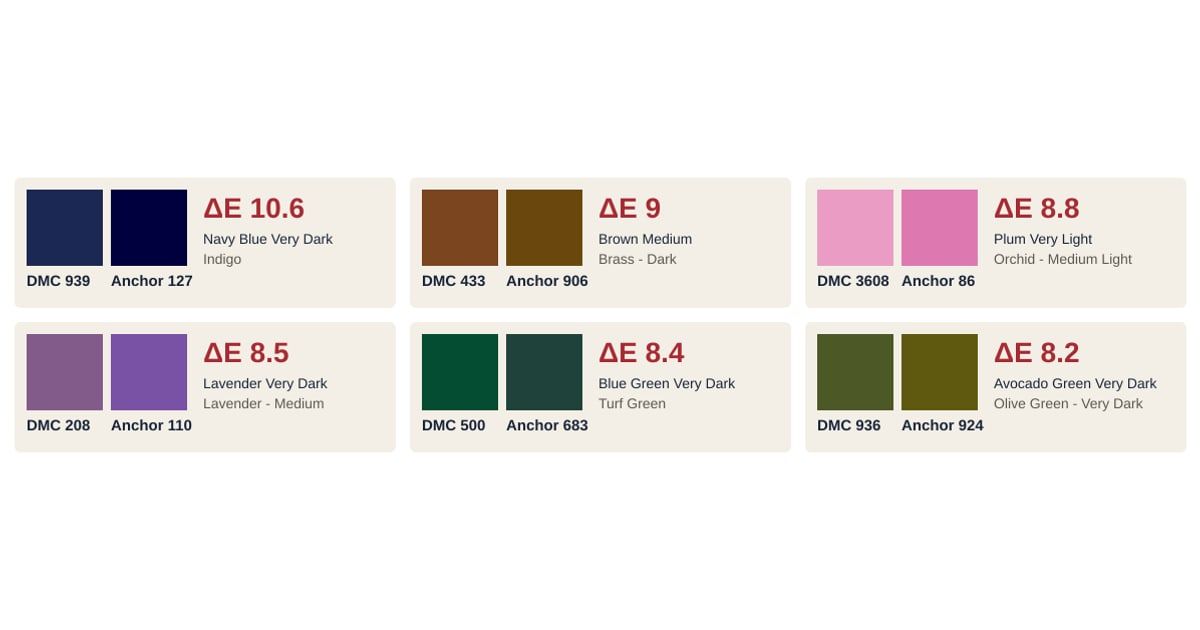
You have a pattern written in Anchor numbers and a drawer full of DMC. Every Anchor to DMC conversion chart you find says "use this one", but few say how close the swap is.
We measured it. Using the Threadhood catalogue, we matched all 445 Anchor threads to their nearest DMC color and scored each pair. The result: most swaps are fine, some are not, and the bad ones are easy to spot.
Below are the counts, the worst offenders and what our own charts showed.
Do Anchor and DMC colors match exactly?
Seldom. Out of 445 Anchor threads, 11 have an exact DMC twin. Another 48 are very close. That is 59 threads, or about 13%, where you would be hard pressed to see a difference.
The rest need more care. Here is how every thread fell, using the same ΔE bands as everywhere on Threadhood: under 1 exact, 1 to 2 very close, 2 to 5 close, 5 or more approximate.
| Match | Anchor to DMC (445 threads) | DMC to Anchor (489 threads) | Threads in our six sample charts (120) |
|---|---|---|---|
| Exact | 11 | 11 | 8 |
| Very close | 48 | 48 | 10 |
| Close | 313 | 344 | 75 |
| Approximate | 73 | 86 | 27 |
| Median ΔE | 3.4 | 3.4 | not measured |
Table 1. Nearest-match quality in both directions, plus the threads our own charts used. Percentages are simple division on these counts. Figures from the Threadhood converter, run on 3 November 2026.
The two directions agree. The median gap is 3.4 either way, and the approximate share is 16% going from Anchor (73 of 445) and 18% going from DMC (86 of 489). So there is no "easy" direction. If you are stitching an Anchor pattern in DMC, you face the same odds as the reverse. Our DMC to Anchor chart lists the other direction in full.
How accurate is an Anchor to DMC conversion chart?
That depends on which threads you need. A median of 3.4 means half of the Anchor threads sit within "close" range. Close is still a visible step in a flat block of background, so look at those too.
We looked for patterns in where the misses fall.
Light colors convert best
We split the 445 Anchor threads into thirds by lightness. The median ΔE for the darkest third was 3.7, the middle third 3.6 and the lightest third 2.7. We did not test why. The gap is small, but it is there.
No hue family is a disaster
We also grouped Anchor threads by hue, and counted how many were approximate in each group:
- Blues: 14 of 81 (17%)
- Greens: 10 of 58 (17%)
- Oranges: 9 of 62 (15%)
- Everything else: 40 of 244 (16%)
Roughly one thread in six is approximate whatever the color. Orange does a little better, but not by much. Do not trust a "greens are safe" rule.
Which Anchor threads convert worst?
Here are the eight worst of the 445, with their nearest DMC thread. Anchor names are Anchor's own.
| Anchor thread | Nearest DMC | ΔE |
|---|---|---|
| 127 Indigo | 939 Navy Blue Very Dark | 10.6 |
| 906 Brass - Dark | 433 Brown Medium | 9.0 |
| 86 Orchid - Medium Light | 3608 Plum Very Light | 8.8 |
| 110 Lavender - Medium | 208 Lavender Very Dark | 8.5 |
| 683 Turf Green | 500 Blue Green Very Dark | 8.4 |
| 924 Olive Green - Very Dark | 936 Avocado Green Very Dark | 8.2 |
| 335 Blaze - Dark | 347 Salmon Very Dark | 8.1 |
| 241 Grass Green | 703 Chartreuse | 7.4 |
Table 2. Eight of the twelve worst Anchor to DMC matches. Figures from the Threadhood converter, run on 3 November 2026.
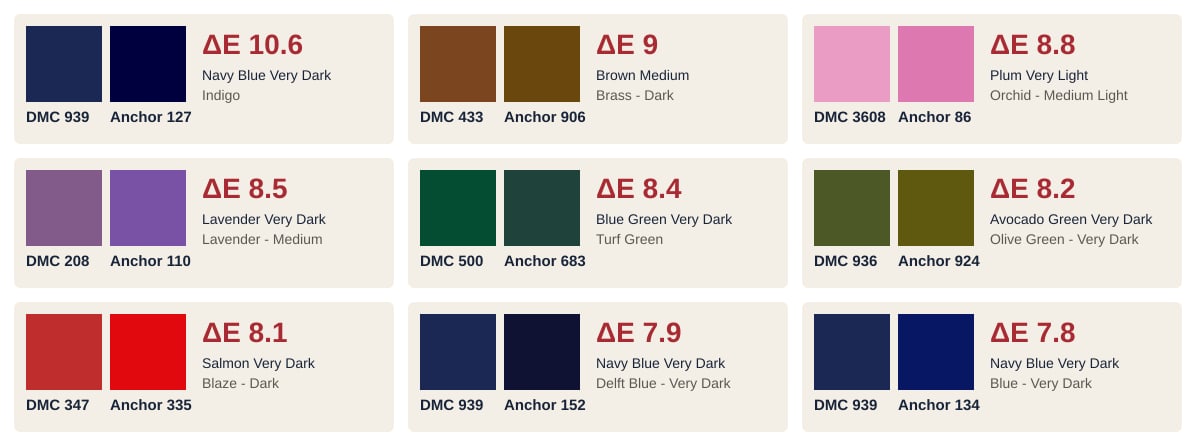
Two things stand out. The dark blues are a trap: Anchor 127, 152 and 134 all point to the same DMC 939, though they are not the same as each other. A nearest-match chart can send three different threads to one. If a pattern uses two of those Anchor colors, converting both to 939 would merge them.
Also, a conversion does not always run backward. In our dog chart, DMC 703 Chartreuse lists Anchor 238 as its nearest, at ΔE 4.1. But Anchor 241 Grass Green lists DMC 703, at 7.4. So 703 is a fair swap for 241 only if you accept the gap.
What our own charts showed
Our charts are DMC charts, with the nearest Anchor match printed beside each thread. Across the six sample charts we made for this site, that adds up to 120 threads. Of these, 8 were exact, 10 very close, 75 close and 27 approximate. That is 23% approximate, higher than the 16% to 18% across the whole catalogue.
We can see the result, not the reason, and six charts is a small sample.
In the 80-wide Labrador chart, 7 of the 20 threads were approximate. Two stood out. DMC 3371 Black Brown maps to Anchor 382 at ΔE 8.3, and DMC 791 Cornflower Blue Very Dark maps to Anchor 941 at 7.8. Both are dark, and both are the ones we would check against real skeins.
That is why the Threadhood key shows the nearest other-brand match and its ΔE for every thread. In the printable PDF kit, loose matches also get an asterisk, so you see them at the shop. The PDF kit is part of the Studio plan.
Using an Anchor to DMC conversion chart well
Start with a routine. List every Anchor code in the pattern. Look each one up and write down the DMC code and the ΔE. Mark anything at 5 or more. Then scan the DMC column for repeats, because two Anchor threads that point to one DMC thread will merge on the chart, and a shaded area can go flat.
Then you have four choices for the rough ones.
- Chart in the brand you own. Set Thread brand to Anchor in the pattern maker and the key uses Anchor numbers from the start. No conversion needed.
- Swap only the approximate ones. Keep exact and very close matches as listed. Check the rest against real skeins in daylight.
- Buy the missing thread. One skein of the right color costs less than a patch you will see every day.
- Blend. DMC describes tweeding this way:
"Tweeded Cross stitch is a way of blending colors by combining strands of different colored embroidery floss in your needle."
That is DMC's technique for effect, not a fix for conversions. If you try it to nudge a rough match, stitch a small swatch first and look at it from a few feet away.
For a quick look-up, our Anchor to DMC conversion chart lists all 445 threads with the nearest DMC code and ΔE. If you only have a DMC number and want a feel for the shade, the DMC color chart helps. For stitch basics, DMC also has a how to cross stitch tutorial page.
One last caution: screen colors and real skeins are not the same, and printed charts vary too. A ΔE is a number from a formula, not a promise about your skein.
Look up any Anchor code in the Anchor to DMC conversion chart, or make a chart in Anchor and skip the conversion.
Frequently asked questions
Do Anchor and DMC colors match exactly?
Rarely. In our check of 445 Anchor threads, 11 had an exact DMC match (ΔE under 1) and 48 had a very close one (1 to 2). Most, 313 of them, were close (2 to 5). The other 73 were approximate (5 or more), which means you may see the difference.
How accurate is a DMC to Anchor conversion?
It is a nearest match by measured color. For all 489 DMC threads the median difference to the nearest Anchor thread is 3.4, and 86 of them are approximate. Treat any Anchor to DMC conversion chart as a starting point, and check the ones marked approximate.
What does ΔE mean on a thread conversion?
ΔE is a measure of how far apart two colors look, here the CIEDE2000 formula. Under 1 is exact, 1 to 2 very close, 2 to 5 close, and 5 or more approximate. Screens vary, so use it to compare matches, not to promise a result.
Can I mix DMC and Anchor in one project?
Many stitchers do. Keep each color area in one brand, so a slight difference does not show as a patch in the middle of a flat area. Check approximate matches against the real skeins in daylight before you stitch.
Try it with your own photo
The pattern maker runs in your browser. No account, no upload, and you see the chart in seconds.
Open the cross-stitch pattern maker